
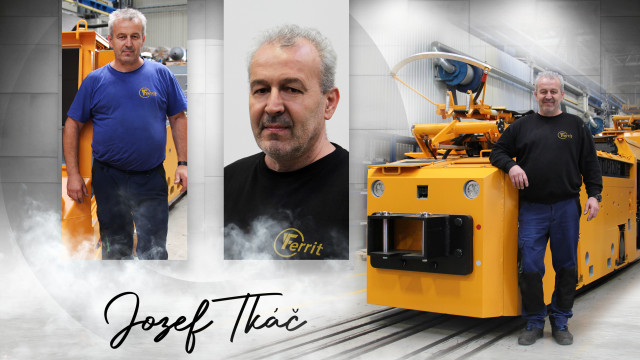
In the assembly of our machines, he plays a key role – not only thanks to his long-term experience, but also thanks to his ability to lead a team and handle the technical challenges that come with every new project. Jozef Tkáč, Assembly Foreman , has been part of Ferrit for 16 years, and during this time he has worked in several professions that gave him a strong foundation for the role he holds today. In this interview, he looks back on his career path, describes the everyday reality of a foreman’s work, and shares what still keeps him motivated. You’ll also get a more personal glimpse into his life – including where he recharges his energy outside of work.
1. Could you tell us about your career path before joining Ferrit?
At the age of eighteen, I started working in construction design, where I spent fifteen years. After that, I moved to HK Konstrukce, where I began working as a metalworker. Five years later, I found a new opportunity at Hamont, a company focused on boiler production. I spent ten years there and eventually returned to construction work, which I continue to do to this day.
2. How long have you been working at Ferrit?
I joined Ferrit on January 4th, 2010, so this year marks sixteen years. During that time, I’ve had the chance to watch the company grow and to be part of many changes and new projects.
3. How many people are on your team, and how do you collaborate?
My team currently consists of 21 people. Each of them has a different personality, which makes working with people both challenging and interesting. I strive for open communication and a fair approach. Our cooperation works well – when something needs to be solved, we pull together.
4. Which machine has been the most challenging to assemble, and why?
The most challenging are always new machines and development projects. They often come with various shortcomings or unclear points in the project documentation that need to be addressed. Together with the design department, we look for ways to correct these issues and improve the assembly process. These projects are demanding, but they also bring the most valuable experience.
5. Do you have a hobby or activity that helps you recharge?
My biggest hobby is working in the garden. It’s a form of relaxation for me and a space I’m constantly trying to improve. Working outdoors gives me energy. And of course, my family plays a big role – my beloved grandson brings me the greatest joy.
6. What technical knowledge and skills do you consider essential for an Assembly Foreman?
A solid understanding of technical drawings is essential. But equally important is working with people – being able to lead them, motivate them, and handle situations that arise during production. Technical knowledge is one thing, but without good communication, it wouldn’t work.
7. What technical challenges do you encounter most often during assembly, and how do you approach them?
Most often, the challenges are related to development projects – various issues that appear during assembly. These may involve errors in technical documentation or inaccuracies in the production of individual parts. We address these situations immediately, usually in cooperation with OTK and the design department, to prevent further complications.
8. Which machine do you enjoy assembling the most? Do you have a favorite?
Among my favorites are definitely the DLP machines, which we’ve been producing for a long time – for example, the DLP140 or DLP50. Each of them has its own specifics and challenges, so I can’t say which one I like the most. Every project is interesting in its own way.
9. If you weren’t a foreman, what career path would you have taken?
If I weren’t a foreman, I would probably have stayed in my previous profession as a mechanic. I always enjoyed that work.
This interview shows that the work of a foreman is not only about technical expertise, but also about people, patience, and the ability to respond to new challenges. Jozef Tkáč is an example of someone who approaches his profession with respect, experience, and long‑term dedication. His story highlights the importance of the people on our shop floor – those who turn drawings into real machines every single day.


 Monorail
 Rail
Rail Trackless
 Optimization
 Mining
 Safety